


From Pilots to Scale: Skills4Retail Partners Meet in Bucharest
After two days of discussion, workshops and industry engagement in Bucharest, the Skills4Retail partnership is looking firmly towards what comes next: how to take what has been developed and tested over the past three years and make it work at a much larger scale across Europe.
Partners from across education, training, research, industry and skills development met in Bucharest on 8 and 9 September to review what Skills4Retail has achieved so far, share lessons from implementation and agree priorities for the next phase of the project.
The meeting marked an important point in the Skills4Retail journey. Much of the research, programme development and piloting is now complete. The focus is increasingly on scaling what works, sharing the resources more widely and creating structures that can continue beyond the lifetime of the project.
From research to real-world training
Skills4Retail began with a clear challenge: to better understand how jobs and skills are changing across Europe’s retail sector and develop practical training that responds to those changes.
Research involving more than 250 retailers, 100 educators and 40 industry experts helped to build that evidence base and informed the development of the European Retail Skills Strategy, five occupational archetypes and 15 personas representing different roles and stages of a retail career.
That research was then translated into training.
The Skills4Retail Emerging Training Programme has now reached 1,432 participants across eight European countries, considerably exceeding its original target of 800 participants. Learners have completed 2,155 training modules.
An earlier Reactive Training Programme reached a further 614 participants across four countries.
Alongside delivery, Skills4Retail has developed modular curricula and supporting learning materials for new entrants, retail employees, managers and trainers, with content adapted for use in different European countries and languages.
What have we learned from delivering across Europe?
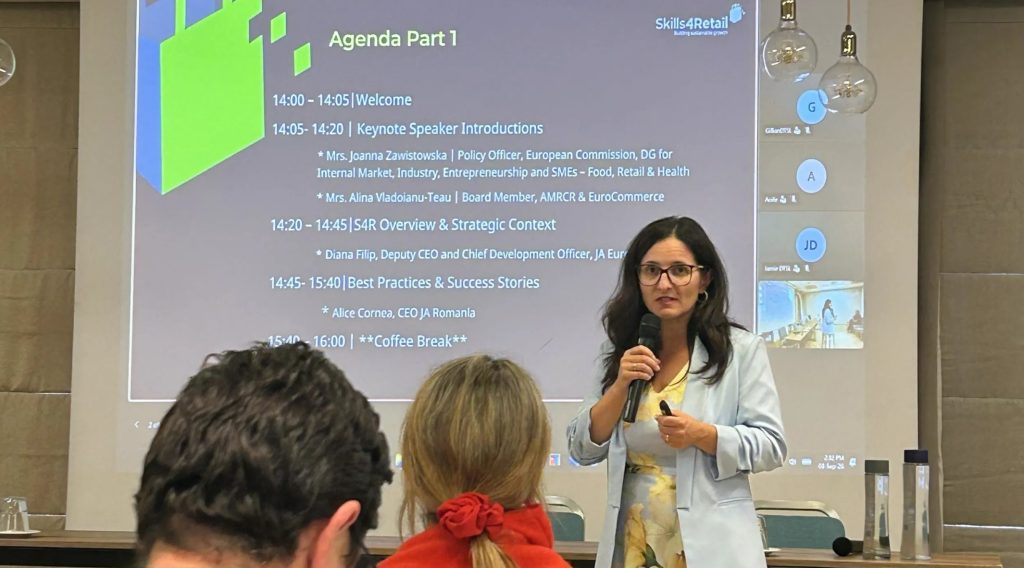
Day one in Bucharest focused heavily on the experience of putting the Skills4Retail approach into practice.
Partners looked at what has worked well, where delivery has needed to be adapted and what those lessons mean for future rollout.
One clear finding is the importance of flexibility. In a sector shaped by shift patterns, changing staffing needs and considerable variation between national education systems, short and modular learning opportunities can be much easier for learners and employers to engage with than longer programmes.
There is no single model that can simply be replicated everywhere. Successful delivery depends on adapting content to the national context and building strong relationships between education and training providers, retailers and organisations already active in each market.
“When we apply for EU funding, we apply to have a lasting impact on our society in the future.”
Diana Filip
Deputy CEO & Chief Development Officer, JA Europe
That idea of lasting impact ran throughout the meeting: how can the knowledge, training approaches and partnerships developed through Skills4Retail become something that continues to deliver value long after the current funding period?
Bringing retailers into the conversation
The Bucharest meeting also created space for direct discussion with industry.
A dedicated stakeholder session brought together Skills4Retail partners, retailers and European-level representatives to look at skills needs, talent attraction, internships, work-based learning and pathways from education into employment.
The discussions explored not only what retailers need from education and training providers, but also the role companies themselves can play by offering practical learning opportunities, internships and closer links with learners.
Strengthening those connections will be important as Skills4Retail moves from individual pilots towards wider implementation.
Where do we go next?
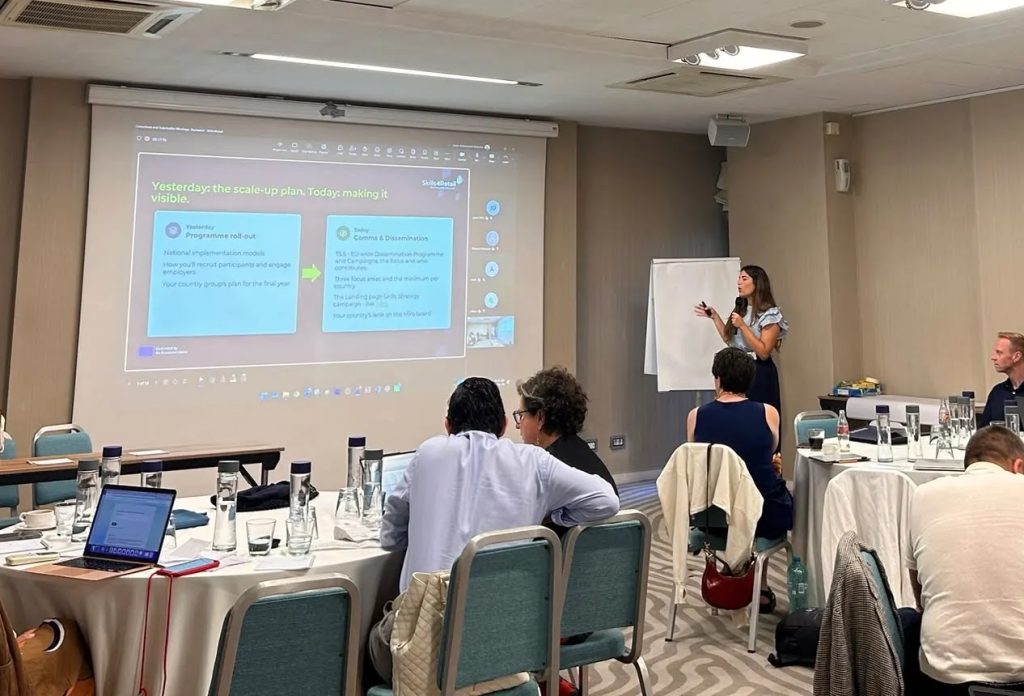
The second day shifted the conversation decisively towards the future.
Partners discussed how Skills4Retail can reach more organisations and learners across Europe, how the work developed by the project can be shared more effectively, and what needs to be put in place to support long-term sustainability.
A major priority is making sure the project’s outputs do not simply remain project deliverables.
Skills4Retail has created a growing collection of practical resources, including occupational profiles, training curricula, micro-credentials, skills intelligence and learning materials. The next challenge is getting those resources into the hands of retailers, employees, educators, training providers and policymakers across Europe and supporting them to put the materials into practice.
Partners also looked at how the European Retail Skills Alliance can continue to grow and provide a community around this work. The Alliance now includes more than 60 pledgers across 11 countries, bringing together education and training providers, employers and sector organisations with a shared interest in developing retail skills.
Building something that lasts
The next phase of Skills4Retail is therefore about more than increasing participant numbers.
It is about turning what has been learned through research and piloting into training that can be used across different national systems, strengthening relationships between employers and education providers, supporting shared approaches to quality and creating routes for the work to continue after the project itself ends.
As the Bucharest meeting came to a close, the direction was clear: take what has been tested, make it easier to use and share it much more widely.
Skills4Retail has built the evidence, training and tools. The focus now is on ensuring they create lasting value for Europe’s retail workforce.
Explore Skills4Retail resources
Skills4Retail resources are available to retailers, employees, educators, training providers and other organisations interested in developing the skills needed for the future of retail.
 Join our mailing list