


Skills and Workforce Trends in Retail: Reflections from a Cross-Border Session
The retail sector continues to evolve, bringing with it changing expectations for both employers and employees. Recent discussions across stakeholders have highlighted a number of shared challenges, from recruitment and retention to the need for continuous upskilling.
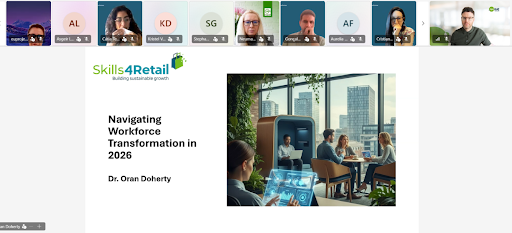
At the same time, many employers continue to face challenges around attracting and retaining staff. In response, there is growing recognition that organisations need to focus not only on recruitment, but on developing the capabilities of their existing workforce. This has led to a stronger emphasis on continuous learning and upskilling, with learning and development becoming a core part of organisational performance.
Another key theme was the increasing importance of the employee experience. Factors such as flexibility, working conditions and opportunities for development are playing a greater role in how employees perceive their roles and whether they choose to remain within an organisation. In this context, improving employee experience is becoming as important as delivering a strong customer experience.
Changes are also evident in the role of managers and leaders. There is a shift away from traditional supervisory roles towards more supportive, coaching-based approaches. This requires a different set of skills, including communication, empathy and the ability to guide teams through ongoing change.
Technology continues to play a central role in these developments. The growing use of AI and digital tools is reshaping everyday tasks, allowing employees to focus more on interaction, problem-solving and customer engagement. Rather than replacing roles outright, these technologies are contributing to the ongoing evolution of work in retail.
Across different countries, many of these trends are consistent, even if the pace of change varies. This underlines the value of creating opportunities for shared learning and exchange across national contexts, where experiences can be compared and practical responses explored.
The role of Skills4Retail and the Retail Large-Scale Partnership
In this context, initiatives such as the Retail Large-Scale Partnership and Skills4Retail play an important role in supporting the sector’s response. By fostering collaboration between industry, education and training providers and creating opportunities for shared learning across countries, they help to bridge the gap between emerging skills needs and practical delivery. Activities such as cross-border sessions and training provision contribute to a more coordinated and responsive approach to workforce development.
Overall, these discussions point to a sector that is adapting continuously. For retail employers, the focus is increasingly on building flexible skills, supporting people effectively, and responding to change in a structured and ongoing way.
Get involved
Organisations and stakeholders interested in contributing to this shared approach are encouraged to engage with the Skills4Retail and Retail LSP initiatives. By participating, they can be part of a collaborative effort to equip the retail sector with the skills needed for both the green and digital transitions.
 Join our mailing list